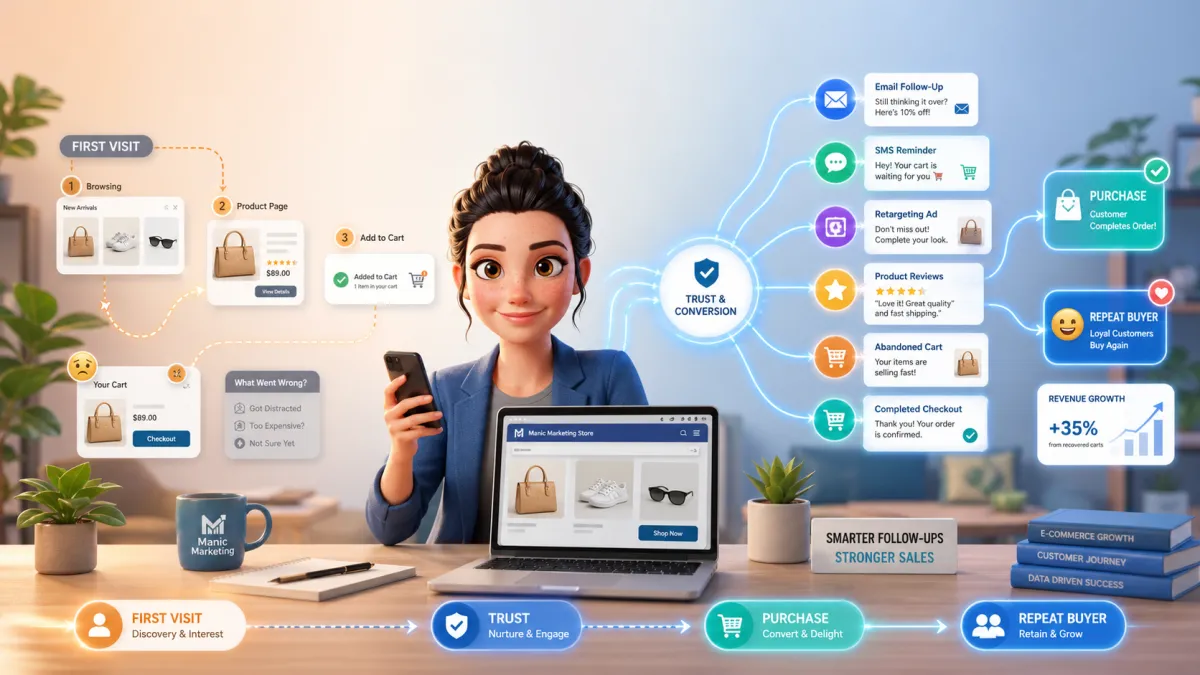
Why Customers Don’t Buy On The First Session
Most e-commerce customers do not buy the first time they visit your store.
That does not mean your product is bad.
It means your marketing needs to do more than get the click.
A first visit is usually the start of the relationship.
Not the finish line.
People browse.
They compare.
They get distracted.
They check reviews.
They wait for payday.
They leave the tab open and forget it exists.
Very human.
Very annoying.
Very normal.
If your e-commerce business only focuses on getting more traffic, you will keep losing money.
The real growth comes from understanding why people hesitate and building systems that bring them back.
Why First-Session Sales Are Rare In E-Commerce
Most customers need more than one touchpoint before they buy.
They may see your ad on Facebook.
Then visit your website.
Then check your Instagram.
Then read a review.
Then compare price.
Then leave.
Then come back after an email, retargeting ad, or SMS reminder.
That is not failure.
That is the buying process.
The mistake is assuming every visitor should buy right away.
That thinking makes business owners panic.
They start blaming the ad.
Then the website.
Then the product.
Then the algorithm.
Sometimes the real issue is simpler.
The customer was not ready yet.
Your First Job Is Not Always The Sale
Your first job is to earn the next step.
That could be:
Getting the visitor to browse another product.
Getting them to add to cart.
Getting them to join your email list.
Getting them to claim a discount.
Getting them to watch a product video.
Getting them to read reviews.
Getting them to save the product.
Getting them to come back later.
The first session should build momentum.
A customer who does not buy today can still buy tomorrow.
But only if you have a system that brings them back.
Reason #1: They Do Not Trust You Yet
Trust is the biggest barrier in e-commerce.
A customer is asking:
Will this product look like the photo?
Will it arrive on time?
Can I return it?
Is this store legit?
Will my card be safe?
What if the product does not work?
What do other customers say?
A nice product page is not enough.
You need trust signals everywhere.
Add reviews.
Add customer photos.
Add shipping details.
Add return policy clarity.
Add secure checkout badges.
Add real FAQs.
Add social proof.
Add clear contact information.
Add product videos when possible.
People buy faster when the risk feels lower.
Your job is to reduce doubt.
Reason #2: They Are Comparing Options
Your customer is not only looking at your product.
They are looking at five other tabs.
Maybe ten.
They are comparing price, reviews, shipping, quality, style, guarantee, and brand vibe.
This is why your product page needs to answer the obvious question:
“Why this one?”
Not with hype.
With substance.
Show what makes the product better.
Show who it is for.
Show what problem it solves.
Show how it compares to cheaper options.
Show what is included.
Show what customers love.
Show the use case clearly.
If your product page looks like every other store, the cheapest option usually wins.
And that is a miserable race to run.
Reason #3: They Are Distracted
People shop while doing 14 other things.
They are scrolling during lunch.
They are watching TV.
They are standing in line.
They are half-listening to a podcast.
They are pretending to work.
No judgment.
We have all been emotionally attached to a cart we forgot about.
Distraction is one of the biggest reasons people leave without buying.
That is why abandoned cart systems matter.
Your follow-up should remind them what they were interested in.
Show the product again.
Address a common objection.
Add urgency when it is real.
Make checkout easy.
Do not act like they betrayed the family by leaving the cart.
Just bring them back.
Reason #4: The Offer Is Not Clear Enough
A confused customer will not buy.
Your offer should be instantly clear.
What is the product?
Who is it for?
What problem does it solve?
What makes it worth the price?
What do they get?
How fast will it ship?
What happens after they order?
If someone has to work too hard to understand the value, they leave.
Your product page should not feel like a scavenger hunt.
Use clear headlines.
Use short descriptions.
Use benefits and details.
Use strong images.
Use simple FAQs.
Use obvious calls to action.
Make buying feel easy.
Reason #5: They Need Proof
Claims do not sell like proof sells.
You can say your product is high-quality.
Every store says that.
You can say customers love it.
Fine.
Show it.
Use reviews.
Use testimonials.
Use customer photos.
Use unboxing videos.
Use product demos.
Use before-and-after content when relevant.
Use screenshots of real feedback.
Use user-generated content.
Proof makes the customer feel less alone in the decision.
They are not just trusting you.
They are trusting the experience of people like them.
That is stronger.
Reason #6: Shipping And Returns Create Friction
A customer can love the product and still abandon the cart because shipping feels unclear.
Surprise fees kill conversions.
Slow shipping kills urgency.
Confusing return policies create doubt.
Make your shipping and return details easy to find.
Answer these questions clearly:
How much is shipping?
How long does delivery take?
Do you offer free shipping over a certain amount?
Can they return the item?
How many days do they have?
What condition does the product need to be in?
Who pays return shipping?
Do not bury this information in tiny footer text like it owes you money.
Put it where buyers need it.
Reason #7: They Are Waiting For A Better Time
Sometimes people want the product.
They just do not want it today.
They are waiting for payday.
They are waiting for a birthday.
They are waiting for a sale.
They are checking with a spouse.
They are deciding between colors or sizes.
They are thinking about whether they really need it.
This is why follow-up is not optional.
If someone showed interest, they should not disappear into the void.
Use email and SMS to stay in front of them.
Send helpful reminders.
Send product education.
Send reviews.
Send styling or usage tips.
Send restock alerts.
Send limited offers when it makes sense.
Timing matters.
Your follow-up keeps you in the running until timing catches up.
Reason #8: Your Checkout Has Too Many Steps
A customer should not need the patience of a monk to place an order.
Long checkout forms hurt sales.
Forced account creation hurts sales.
Unexpected fees hurt sales.
Slow pages hurt sales.
Unclear payment options hurt sales.
Make checkout simple.
Offer guest checkout.
Show accepted payment methods.
Make the cart easy to edit.
Keep the process clean.
Make discount codes easy to apply.
Show delivery estimates before the final step.
Every extra bit of friction gives the customer another chance to leave.
And customers are very good at leaving.
Olympic-level, honestly.
Reason #9: Your Brand Has Not Built Enough Familiarity
People buy from brands they remember.
That does not happen in one visit.
It happens through repeated exposure.
Ads.
Emails.
Social content.
Retargeting.
Influencer content.
Customer reviews.
Short-form videos.
Product demos.
Helpful tips.
Behind-the-scenes posts.
A customer might not buy after seeing your product once.
But after seeing it five, seven, or ten times in different ways, trust starts to build.
That is why consistency matters.
Not random posting.
Not “we remembered we have Instagram” posting.
Actual consistency.
Reason #10: Your Follow-Up Is Weak Or Missing
This is where e-commerce businesses lose the most money.
They spend money to get traffic.
They get visitors.
They get add-to-carts.
They get abandoned checkouts.
Then nothing.
No strong email sequence.
No SMS follow-up.
No retargeting strategy.
No product education.
No review reminders.
No win-back campaigns.
That is like paying to bring people into your store and then turning the lights off.
Your follow-up should do the selling after the first session ends.
Because for most customers, that is when the real decision starts.
What Your E-Commerce Follow-Up Should Include
You need more than one abandoned cart email.
That is bare minimum marketing.
A strong follow-up system should include:
Welcome emails for new subscribers.
Abandoned cart reminders.
Abandoned checkout reminders.
Browse abandonment emails.
Post-purchase emails.
Review requests.
Win-back campaigns.
Cross-sell campaigns.
VIP customer campaigns.
Back-in-stock alerts.
Product education sequences.
SMS reminders for high-intent shoppers.
The goal is simple.
Keep the relationship moving.
How AI Helps E-Commerce Businesses Convert More Visitors
AI can help e-commerce brands follow up faster, write better content, and personalize communication at scale.
That matters because your customers are not all in the same stage.
Some are first-time visitors.
Some are cart abandoners.
Some are past buyers.
Some are loyal customers.
Some bought once and vanished.
Some looked at one product five times and never checked out.
AI can help segment those people and create smarter messages for each group.
That means your follow-up can feel more relevant.
Less generic.
Less lazy.
More likely to convert.
AI Can Help You Turn Behavior Into Sales
Every action tells you something.
A product page view shows interest.
An add-to-cart shows higher intent.
An abandoned checkout shows serious intent.
A repeat purchase shows loyalty.
A review shows trust.
A long gap after purchase shows a win-back opportunity.
AI can help organize those signals and turn them into campaigns.
For example:
A customer viewed sunglasses but did not buy.
Send a style guide.
A customer abandoned checkout.
Send a reminder with reviews.
A customer bought skincare.
Send usage tips and a refill reminder.
A customer bought a gift item.
Send seasonal gifting ideas later.
A customer has not purchased in 90 days.
Send a comeback offer.
This is how e-commerce brands stop blasting everyone with the same message.
They start marketing based on behavior.
That is smarter.
Paid Ads Get The Click.
Follow-Up Gets The Customer.
Ads matter.
But ads alone do not build a profitable e-commerce business.
Your ad gets attention.
Your store creates desire.
Your proof builds confidence.
Your follow-up brings people back.
Your customer experience creates repeat sales.
That is the full system.
If one piece is missing, revenue leaks.
Most e-commerce businesses do not need more random traffic.
They need better conversion systems around the traffic they already have.
What To Fix Before Spending More On Ads
Before increasing your ad budget, check the basics.
Is your product page clear?
Are your reviews easy to find?
Is your shipping information obvious?
Is checkout simple?
Do you have abandoned cart emails?
Do you have abandoned checkout emails?
Do you have SMS follow-up?
Do you have retargeting ads?
Do you have customer photos or videos?
Do you have a welcome offer?
Do you have post-purchase emails?
Do you have a win-back campaign?
If the answer is no, more ad spend will only expose the holes faster.
That is not scaling.
That is pouring gas into a leaky lawn mower and calling it strategy.
Short-Form Content Supports The Buying Journey
Short-form content is especially useful for e-commerce brands.
A customer may not buy from one ad.
But they may buy after seeing your product used in real life.
Show the product in action.
Show how it fits.
Show how it solves a problem.
Show customer reactions.
Show packaging.
Show before and after.
Show comparisons.
Show styling ideas.
Show common mistakes.
Show FAQs.
Content builds trust between sessions.
That trust makes the next visit stronger.
Your First-Session Goal Should Be Clear
Not every visitor will buy immediately.
So decide what you want them to do next.
For cold visitors, your goal may be:
Join the email list.
Claim a first-time buyer offer.
View best sellers.
Take a quiz.
Watch a product demo.
For warm visitors, your goal may be:
Add to cart.
Complete checkout.
Use a discount.
Bundle products.
Buy again.
For past buyers, your goal may be:
Leave a review.
Buy a refill.
Try a related product.
Join a loyalty program.
Refer a friend.
Different customers need different next steps.
Your store should guide them clearly.
Why Repeat Buyers Matter More Than One-Time Buyers
A first purchase is valuable.
A repeat buyer is better.
Repeat buyers trust you more.
They cost less to reach.
They are easier to convert.
They can refer others.
They can leave reviews.
They can become the proof that helps new customers buy.
This is why post-purchase marketing matters.
Do not disappear after the sale.
Send product tips.
Ask for feedback.
Recommend related products.
Offer loyalty rewards.
Invite reviews.
Create a reason to come back.
The sale should start the relationship.
Not end it.
How Manic Marketing Helps E-Commerce Businesses
Manic Marketing helps business owners use AI marketing tools to generate more leads, book more appointments, and close more sales.
For e-commerce businesses, that means helping turn clicks into customers and customers into repeat buyers.
That can include AI-powered content creation, warm email campaigns, follow-up systems, website strategy, and smarter customer communication.
The goal is not just more traffic.
The goal is more revenue from the traffic you already worked hard to get.
Because getting the visitor is only part of the job.
Getting them to come back and buy is where the money is made.
Final Takeaway
Customers do not buy on the first session because buying takes trust.
They need proof.
They need clarity.
They need time.
They need reminders.
They need fewer reasons to hesitate.
Your job is not to panic when they leave.
Your job is to bring them back with smarter systems.
Strong product pages.
Clear proof.
Simple checkout.
Useful content.
Email follow-up.
SMS reminders.
Retargeting.
AI-powered segmentation.
That is how e-commerce businesses turn first visits into future sales.
Not by hoping every click converts.
By building a system that keeps selling after the first visit ends.
Want Help Turning More Store Visitors Into Buyers?
Book a complimentary strategy call with the Manic Marketing team here:
https://manicmarketing.com/strategy-session
When you book, you will also get access to a 100% free AI Content Marketing tool.
It connects to your business social media profiles.
It uses AI to create content.
It can auto-post across up to 8 different platforms.
If your store is getting clicks but not enough sales, now is the time to fix the follow-up.
