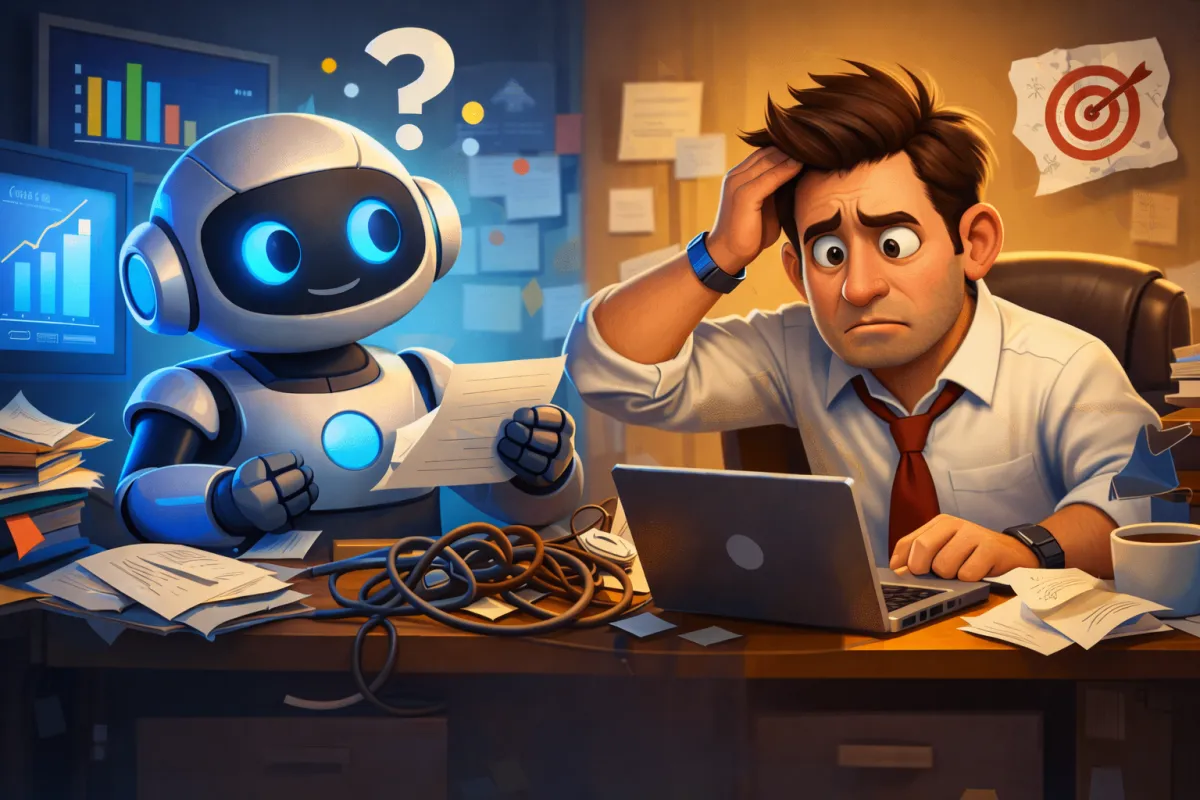
Why AI Tools Alone Don’t Work Without Strategy
AI tools are everywhere right now.
And a lot of business owners are buying them, testing them, and then wondering why nothing really changes.
The problem is not the tool.
The problem is the lack of strategy behind it.
If you hand someone a race car with no map, no training, and no finish line, they might move fast.
But they will not move in the right direction.
AI Can Speed Things Up
But It Cannot Build the Plan for You
More businesses are using AI for lead generation, content creation, follow-up, customer service, and sales support.
That sounds great.
But tools do not build businesses.
Strategy does.
Systems do.
Direction does.
AI can help you move faster.
It can automate tasks.
It can save time.
But it cannot decide your offer.
It cannot fix weak messaging.
It cannot tell you who your ideal customer is if you have not figured that out yourself.
And it cannot turn a messy business into a scalable one just because you turned on a few automations.
That is where many business owners get stuck.
They buy the tool before they build the plan.
AI Without Strategy Creates Faster Mistakes
A lot of business owners think AI will solve a growth problem overnight.
So they start using tools to post more content, send more messages, write more emails, or automate more steps.
But more activity does not always mean more results.
If your message is off, AI will scale the wrong message.
If your targeting is weak, AI will help you reach the wrong people faster.
If your follow-up process is broken, AI will automate the broken process.
That is the part most people miss.
AI makes things faster.
It does not automatically make them better.
So if the strategy is weak, the output will still be weak.
You just get weak results at a higher volume.
Tools Do Not Replace Clear Thinking
This is where a lot of business owners get sold a fantasy.
They hear phrases like fully automated growth and assume strategy no longer matters.
That is false.
Every tool still needs direction.
You still need to know who you want to reach.
You still need to know what problem you solve.
You still need to know what offer you want to lead with.
You still need to know what action you want people to take.
You still need to know how you will follow up.
You still need to know how you will track what is working.
Without those answers, AI is just guessing.
And guessing is expensive.
Strategy Gives AI a Job to Do
The real value of AI shows up when it is plugged into a clear business strategy.
That means the tool is not just doing random tasks.
It is supporting a real objective.
If your goal is to generate qualified leads, your AI tools should support prospecting, filtering, outreach, and follow-up.
If your goal is to book more appointments, your AI tools should help move people from interest to action.
If your goal is to increase sales, your AI tools should help nurture leads, answer objections, and keep your pipeline moving.
The tool is not the strategy.
The tool serves the strategy.
That one shift changes everything.
Why Some Businesses Win With AI and Others Do Not
The businesses getting results with AI are not stacking random software and hoping it works.
They are building simple systems around real business goals.
They know what success looks like.
They know what numbers matter.
They know where leads are coming from.
They know what message gets attention.
They know how prospects move from cold to warm to ready.
Then they use AI to make that process more efficient.
That is why one business can use AI and see real growth while another gets almost nothing from the same type of tool.
Same category of software.
Different level of strategy.
A Simple Real-World Example
Let’s say two roofing companies both start using AI.
The first company uses AI to write social media posts every day.
The second company uses AI as part of a full lead generation system.
The second company has a clear offer.
They know their service area.
They know the type of homeowner they want.
They use AI to identify prospects, start conversations, follow up fast, and keep leads organized.
The first company is posting.
The second company is building pipeline.
That is the difference.
AI content alone does not grow a business.
A strategy-backed system does.
The Biggest Mistake Business Owners Make With AI
They focus on what the tool can do instead of what the business actually needs.
That leads to shiny object syndrome.
One week it is an AI content writer.
The next week it is a chatbot.
Then an automation platform.
Then a cold outreach tool.
Then a CRM add-on.
Now they have multiple subscriptions, too many logins, and no real process.
That is not scale.
That is clutter.
A better question is this:
What is the actual constraint in the business right now?
Do you need more leads?
Do you need better follow-up?
Do you need more appointments booked?
Do you need better conversion from warm leads?
Do you need content that supports sales?
Once you know the bottleneck, the right AI tool becomes a lot easier to choose.
What a Real AI Strategy Looks Like
A real AI strategy does not need to be complicated.
It just needs to be intentional.
At a basic level, it should answer these questions.
1. What is the main goal?
Pick one priority first.
More leads.
More appointments.
More sales.
More retention.
Do not try to fix everything at once.
2. Who are you trying to reach?
Be specific.
A business that tries to talk to everyone usually connects with no one.
3. What offer are you putting in front of them?
If the offer is weak, no tool can save it.
4. What happens after someone responds?
This is where many businesses lose money.
They generate interest, then fail in the follow-up.
5. What metrics matter most?
Track more than clicks and views.
Look at leads, conversations, appointments, close rates, and revenue.
That is how strategy keeps AI useful.
It gives every tool a purpose.
Why AI Feels Disappointing for Some Businesses
Because they expected the software to carry the weight of a real marketing plan.
It cannot do that.
AI can support your growth.
It can speed up what already works.
It can remove manual work.
It can help you stay consistent.
But it is not a replacement for positioning, planning, messaging, and process.
If your business lacks those things, AI will expose the gap quickly.
That is not bad news.
That is useful news.
Because once you see the real issue, you can fix it.
Where Manic Marketing Fits In
This is exactly why businesses work with Manic Marketing.
Not because they need more random tools.
Because they need a smarter way to use them.
We help business owners build practical AI marketing systems tied to real outcomes.
More leads.
More booked appointments.
More closed sales.
That might mean using AI to start and manage conversations through personal social platforms.
That might mean using warm email strategy to activate an existing lead list.
That might mean tightening up the full customer journey so the tools finally work together instead of pulling in different directions.
The point is simple.
AI works best when it is part of a clear system.
That is what we build.
Ready to Make AI Actually Work for Your Business?
If your tools are not producing the results you expected, the fix is usually not another tool.
The fix is the strategy behind it.
Book a complimentary strategy call with Manic Marketing here:
https://manicmarketing.com/strategy-session
When you book, you will also get a 100 percent free AI content marketing tool that connects to your business’s social media profiles, helps create content, and auto-posts across up to 8 different platforms.
