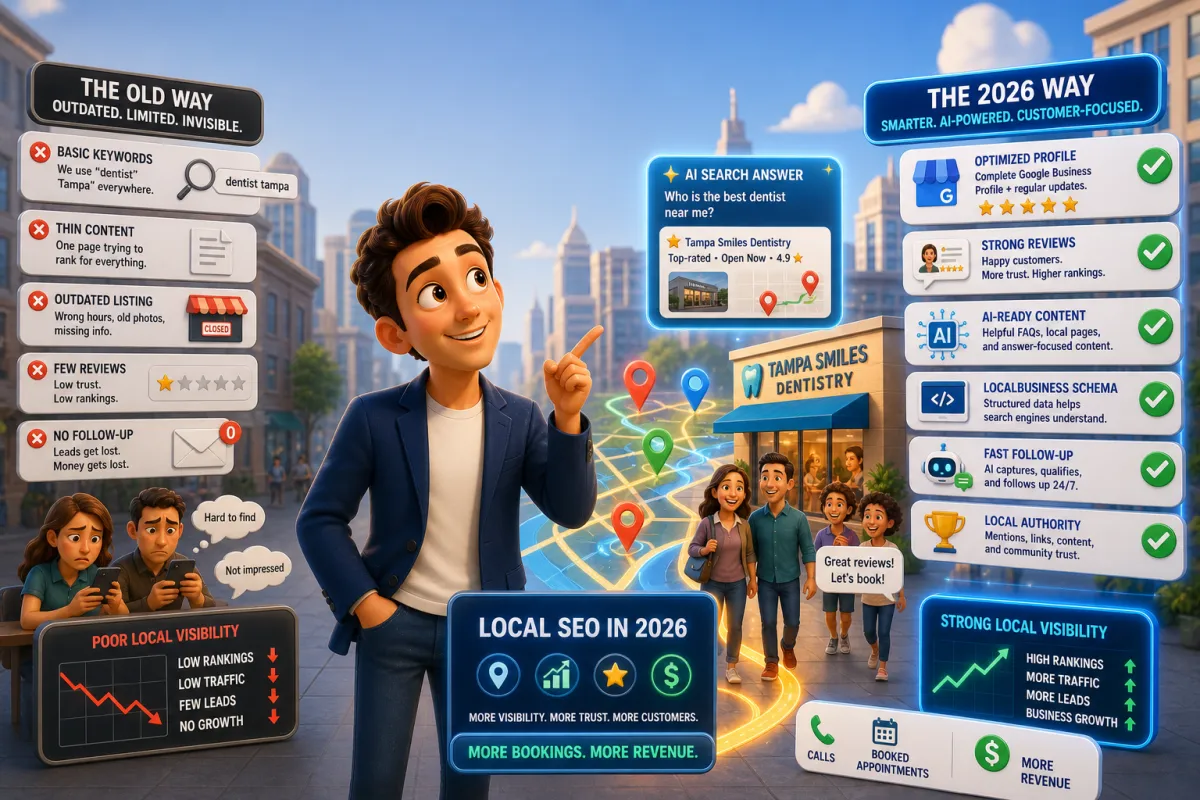
What Local SEO Looks Like In 2026
Local SEO is no longer just about showing up when someone types “near me.”
It is about becoming the trusted local answer across Google Search, Google Maps, AI Overviews, voice search, and the customer’s own decision process.
That means your business needs more than keywords.
It needs proof, clarity, consistency, and a website that helps both people and search engines understand why you are the right choice.
Local SEO in 2026 is not dead.
It is just more demanding.
And honestly, that is good news for businesses willing to do it right.
What Is Local SEO In 2026?
Local SEO is the process of helping your business show up when nearby customers search for what you sell.
That includes searches like:
“Best medspa near me.”
“Emergency dentist in Tampa.”
“Chiropractor for back pain near me.”
“Roof repair company in Dallas.”
“Best facial in Calgary.”
“AI marketing agency for small businesses.”
But in 2026, local SEO goes beyond the old checklist.
Your business needs to show up in:
Google Maps.
Google Business Profile results.
Organic search.
AI-generated answers.
Review-based searches.
Voice search.
Local service searches.
Mobile search.
Industry-specific searches.
That means your local presence needs to be clear from every angle.
Because customers are not only finding you from one place anymore.
They are piecing together trust from many places.
The Old Local SEO Playbook Is Not Enough
The old local SEO playbook was simple.
Add your city to your website.
Claim your Google Business Profile.
Get a few reviews.
Build some citations.
Write a few service pages.
That still matters.
But it is not enough by itself.
Google says local rankings are based mainly on relevance, distance, and prominence.
That means Google is trying to understand three things:
Does your business match the search?
Is your business close enough to the searcher?
Does your business look credible enough to recommend?
In 2026, that third part is where a lot of businesses win or lose.
Prominence is built through reviews, reputation, content, links, business information, and overall trust signals.
Translation:
You cannot fake being the best local option for long.
The internet keeps receipts.
Google Business Profile Is Still The Local SEO Foundation
Your Google Business Profile is one of the most important local marketing assets your business owns.
For many customers, it is the first impression.
Not your website.
Not your Instagram.
Your Google listing.
Google says complete and accurate business information helps businesses show up in local search results.
That means your profile needs to be fully built out.
Not halfway done.
Not “we added it three years ago and never touched it again.”
Actually maintained.
Your Google Business Profile should include:
Correct business name.
Correct address.
Correct phone number.
Correct website link.
Accurate business hours.
Main business category.
Secondary categories.
Detailed services.
Strong photos.
Fresh updates.
Review responses.
Appointment or contact links.
Clear business description.
This is not busywork.
This is trust infrastructure.
Reviews Matter More Than Ever
Reviews are local SEO fuel.
They help customers decide.
They help Google understand prominence.
They help AI-powered search tools summarize public trust.
A business with weak reviews is going to have a harder time winning local attention.
Especially in competitive markets.
Think salons.
Medspas.
Dentists.
Chiropractors.
Roofers.
HVAC companies.
Real estate.
Insurance.
Home services.
Business funding.
Marketing services.
These are trust-heavy categories.
People want proof before they call.
Your review strategy should be consistent.
Not desperate.
Not fake.
Not bribed.
Consistent.
Ask happy customers.
Make it easy.
Respond to reviews.
Use feedback to improve the experience.
A five-star review is great.
A detailed five-star review that mentions the service, result, location, and experience is better.
That gives future customers more confidence.
It also gives search engines more context.
Local SEO Is Now Answer-Based
Customers are asking better questions.
Search engines are giving more direct answers.
That changes how businesses need to write content.
People are not only searching:
“Chiropractor near me.”
They are searching:
“Who is the best chiropractor for lower back pain near me?”
“What should I expect at my first chiropractic appointment?”
“How much does teeth whitening cost in my area?”
“What is the best facial for acne-prone skin?”
“Is it better to repair or replace my roof?”
That means local SEO in 2026 overlaps with Answer Engine Optimization.
Your website needs to answer real buyer questions clearly.
Not hide answers behind vague service pages.
Not bury the good information under six paragraphs of fluff.
Clear questions.
Clear answers.
Helpful pages.
Simple structure.
Google’s search guidance says its ranking systems are designed to prioritize helpful, reliable, people-first content.
That is the standard.
Write for the customer first.
Make it easy for search engines to understand second.
AI Overviews Changed The Local Search Game
AI is now part of how people search.
Google has continued weaving AI deeper into Search, including AI Overviews and AI-driven search experiences.
For local businesses, this matters because customers may get answers before they ever click a website.
That does not mean websites are useless.
It means websites need to become clearer, more useful, and more trustworthy.
If AI tools are summarizing local options, your business needs strong signals everywhere.
Your Google Business Profile.
Your reviews.
Your website.
Your service pages.
Your FAQs.
Your business details.
Your online mentions.
Your content.
Your consistency.
AI cannot confidently recommend what it cannot clearly understand.
Do not make the machine guess.
It is already weird enough.
Your Website Still Matters
Some business owners think Google Business Profile is enough.
Wrong.
Your profile matters.
But your website still supports your local authority, trust, and conversion.
Google’s SEO Starter Guide emphasizes content that is helpful, reliable, unique, and up to date.
That means your website should not be a dusty online brochure.
It should be an active sales and trust asset.
Your website should include:
Service pages.
Location pages when relevant.
FAQ sections.
Review highlights.
Case studies.
Before-and-after examples when appropriate.
Clear calls to action.
Fast loading speed.
Mobile-friendly design.
Strong internal linking.
Helpful blog content.
Local proof.
Simple booking paths.
A visitor should understand what you do, where you serve, why you are credible, and what to do next within seconds.
If they cannot, your website is leaking leads.
LocalBusiness Schema Helps Search Engines Understand You
Schema is behind-the-scenes website code that helps search engines understand your business information.
It can identify things like:
Business type.
Address.
Phone number.
Hours.
Departments.
Services.
Reviews.
Reservation or booking options.
Google explains that LocalBusiness structured data can help Google understand and display details about a business in Search and Maps.
You do not need to become a technical SEO wizard.
Please do not buy the cape.
But your website team should know how to add the right structured data.
This helps search engines connect the dots.
And in 2026, connected dots matter.
Local Content Needs To Be Specific
Generic content is not enough.
A blog called “Why Dental Care Matters” is fine.
But it is weak.
A blog called “How To Choose The Right Family Dentist In Austin” is stronger.
A service page called “Facials” is fine.
A page called “Hydrating Facial For Dry Skin In Calgary” is stronger.
A chiropractor page called “Back Pain Treatment” is fine.
A page that explains lower back pain treatment for office workers in your city is stronger.
Local SEO rewards relevance.
Specific content creates relevance.
Your content should answer questions tied to your services, your market, and your customer’s buying process.
Examples:
“What To Know Before Booking Botox In [City].”
“How Often Should You Schedule A Chiropractic Adjustment?”
“What To Do After A Storm Damages Your Roof In [City].”
“How To Choose A Medspa Near You Without Picking The Cheapest Option.”
“What Local Business Owners Should Know Before Hiring A Marketing Agency.”
That is useful content.
Not filler.
Photos And Visual Proof Matter
Local SEO is not only text.
Photos matter because they help customers trust what they are looking at.
Your Google Business Profile and website should include real visuals.
Your building.
Your team.
Your work.
Your products.
Your treatment rooms.
Your results.
Your process.
Your happy customers when appropriate.
Your before-and-after images when allowed and compliant.
Stock photos are not the enemy.
But if your whole brand looks like it was assembled from the same five people smiling at laptops, customers notice.
Real visuals build confidence.
And confidence creates action.
Local SEO And Conversion Are Now Connected
Ranking is not the finish line.
A lot of businesses obsess over being found.
Then they forget to convert the visitor.
Bad move.
Local SEO should lead to action.
Calls.
Bookings.
Form fills.
Store visits.
Consultations.
Purchases.
That means your pages need clear next steps.
Use calls to action like:
Book Your Appointment.
Schedule A Consultation.
Call Now.
Get A Quote.
Claim Your New Client Offer.
Request Pricing.
Start Your Strategy Call.
Do not make visitors hunt.
They have the patience of a squirrel near traffic.
Make the next move obvious.
Speed To Lead Affects Local Growth
Local SEO gets people to your business.
Follow-up turns them into customers.
If someone fills out a form and waits two days for a response, you probably lost them.
If someone calls and nobody answers, they will call the next business.
If someone messages your profile and hears nothing, momentum dies.
This is where AI follow-up matters.
A strong local SEO system should connect with:
CRM automation.
Missed call text-back.
Appointment reminders.
Lead follow-up.
Review requests.
Reactivation campaigns.
AI chat.
Email nurturing.
SMS follow-up.
Local SEO should not stop at traffic.
It should feed the pipeline.
Your Reputation Is Part Of SEO
In 2026, reputation and visibility are tied together.
Search engines, AI tools, and customers all look for trust signals.
That includes:
Reviews.
Ratings.
Review responses.
Local mentions.
Case studies.
Customer stories.
Consistent information.
Helpful content.
Clear service details.
Professional website experience.
If your reputation is weak, SEO gets harder.
If your reputation is strong, SEO gets easier.
That does not mean you can ignore technical work.
It means trust is now part of the machine.
What Local SEO Looks Like By Industry
Local SEO is not one-size-fits-all.
A dentist and a roofer should not have the same strategy.
A medspa and a mortgage broker should not have the same content plan.
Here is how it changes by industry.
Salons And Medspas
Focus on service pages, reviews, photos, treatment education, memberships, local offers, and booking ease.
Show the experience.
Explain the treatment.
Build trust before the appointment.
Dentists And Chiropractors
Focus on condition-based pages, patient FAQs, reviews, emergency pages, insurance clarity, location relevance, and appointment booking.
Patients want trust and comfort.
Give them both.
Roofers And HVAC Companies
Focus on emergency service pages, city pages, review proof, seasonal content, before-and-after work, and fast quote requests.
Speed matters.
Trust matters more.
Real Estate And Mortgage Professionals
Focus on local market guides, neighborhood content, buyer and seller questions, reviews, educational content, and lead capture.
People need guidance before they need a pitch.
Coaches And Consultants
Focus on authority content, case studies, clear offers, niche-specific pages, and strong calls to action.
Your website needs to prove you understand the buyer’s problem.
E-Commerce With Local Presence
Focus on product pages, local pickup, reviews, Google listings, content around product use, and repeat customer campaigns.
Local trust can support online sales.
The Local SEO Checklist For 2026
Use this as your starting point.
1. Fully Optimize Your Google Business Profile
Complete every major section.
Add services.
Update hours.
Add photos.
Use the right categories.
Respond to reviews.
Post updates.
2. Build Strong Service Pages
Each major service needs its own page.
Do not cram everything onto one generic services page.
3. Add Local Proof
Use reviews, local photos, customer stories, service area details, and real examples.
4. Create Helpful FAQ Content
Answer real questions customers ask before they buy.
Keep answers short and useful.
5. Add LocalBusiness Schema
Help search engines understand your business details more clearly.
6. Improve Mobile Experience
Most local searches happen on mobile.
Your site should load fast and make calls or bookings easy.
7. Publish Local Content
Write about local questions, local problems, local services, and local buying decisions.
8. Build A Review System
Ask consistently.
Respond consistently.
Use reviews as proof.
9. Connect SEO To Follow-Up
Use automation, CRM workflows, AI chat, email, and SMS to turn search traffic into booked opportunities.
10. Track Real Business Outcomes
Do not only track rankings.
Track calls, bookings, form fills, appointments, revenue, and pipeline movement.
That is what pays the bills.
What Businesses Should Stop Doing
Some local SEO habits need to be retired.
Stop keyword stuffing city names.
Stop creating thin city pages with copied content.
Stop ignoring reviews.
Stop using fake locations.
Stop letting old hours sit unchanged.
Stop publishing generic blogs nobody needs.
Stop treating your website like a business card.
Stop thinking SEO ends when someone lands on the site.
Stop chasing rankings without tracking revenue.
Local SEO is not about tricking Google.
It is about becoming the clearest and most trusted local choice.
Much less sneaky.
Much more profitable.
How AI Changes Local SEO In 2026
AI makes local SEO faster and smarter.
It can help:
Find content gaps.
Write FAQ drafts.
Create local blog ideas.
Repurpose reviews into content.
Build service page outlines.
Create Google Business Profile posts.
Draft review responses.
Generate email follow-ups.
Create social content.
Analyze customer questions.
Support website personalization.
But AI still needs direction.
Do not let it create generic content that sounds like every other business in your city.
Use AI to speed up your strategy.
Not replace your brain.
That thing still has a job.
How Manic Marketing Helps
Manic Marketing helps business owners use AI marketing tools to generate more leads, book more appointments, and close more sales.
Local SEO fits directly into that.
Because showing up locally means nothing if your website, follow-up, and content do not convert attention into action.
We help businesses build smarter marketing systems that connect local visibility with AI-powered content, follow-up, appointment booking, email marketing, website strategy, and pipeline movement.
The goal is not just more traffic.
The goal is more customers.
Big difference.
Final Takeaway
Local SEO in 2026 is about trust, clarity, and action.
Your business needs accurate listings.
Strong reviews.
Helpful local content.
A clear website.
Structured data.
Fast follow-up.
AI-ready answers.
A system that turns search visibility into real revenue.
The businesses that win locally will not be the ones trying to hack the algorithm.
They will be the ones making it painfully obvious why customers should choose them.
That is the real local SEO strategy now.
Be clear.
Be useful.
Be trusted.
Be easy to contact.
Then make sure every lead gets followed up with fast.
Want Help Making Your Business The Obvious Local Choice?
Book a complimentary strategy call with the Manic Marketing team here:
https://manicmarketing.com/strategy-session
When you book, you will also get access to a 100 percent free AI Content Marketing tool.
It connects to your business’s social media profiles.
It uses AI to create content.
It can auto-post across up to 8 different platforms.
If your local SEO is getting attention but not enough leads, bookings, or sales, now is the time to fix the full system.
