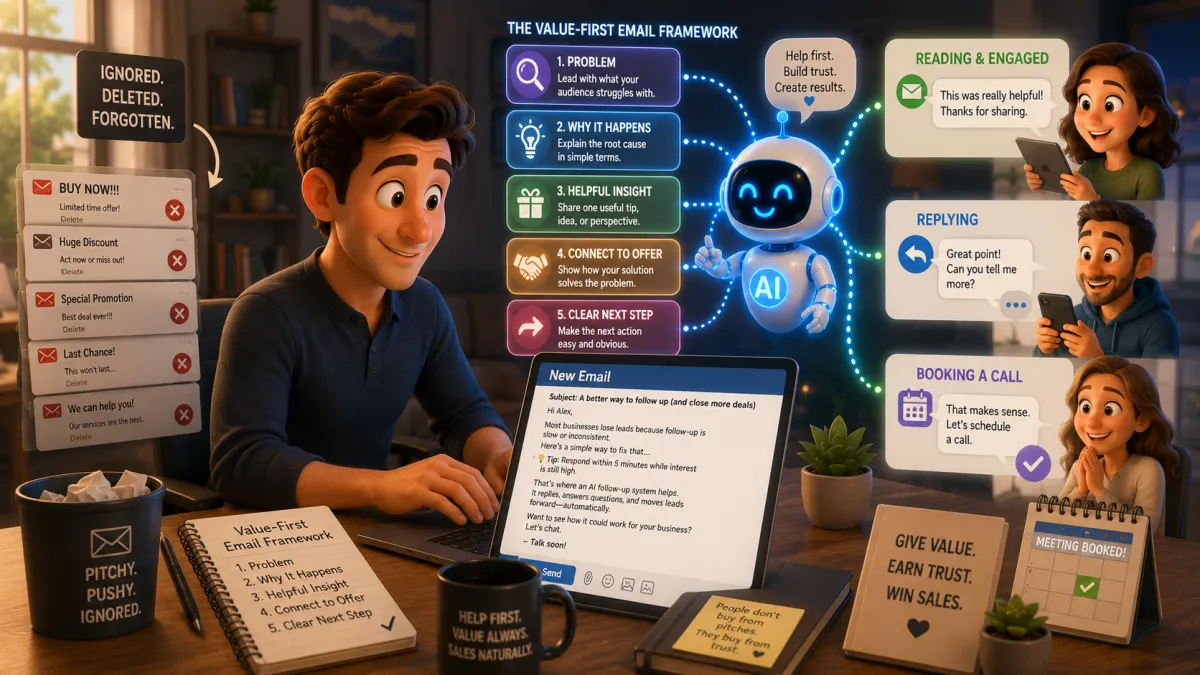
The Value-First Email Framework: How To Sell Without Sounding Like A Salesman
Nobody wants another sales email clogging up their inbox.
But people will read an email that helps them solve a problem, avoid a mistake, or make a smarter decision.
That is the difference between selling with pressure and selling with value.
Why Most Sales Emails Get Ignored
Most sales emails feel the same.
They lead with the offer.
They talk too much about the business.
They try to create urgency too soon.
They ask for action before earning attention.
That is why people tune them out.
Your prospect does not care that you have a service to sell.
They care about what is costing them time, money, stress, or opportunity.
Start there.
What Value-First Email Means
A value-first email gives before it asks.
It teaches something useful.
It calls out a real problem.
It explains a mistake to avoid.
It gives a simple next step.
Then it connects the lesson back to your offer naturally.
No hard pitch.
No awkward pressure.
No “just checking in” nonsense.
The email should feel like helpful advice from someone who knows what they are talking about.
That is what earns replies.
Why Value Builds Trust Faster
People buy from businesses they trust.
But trust does not come from saying, “We can help.”
Trust comes from showing that you understand the problem better than everyone else.
A strong email should make the reader think:
“They get it.”
“That makes sense.”
“I needed to hear that.”
“That sounds like my situation.”
Once the reader feels understood, your offer becomes more relevant.
That is how you sell without sounding desperate.
The Value-First Email Framework
1. Start With The Problem
Lead with something your audience already feels.
Do not start with your company.
Do not start with your service.
Start with the pain.
For example:
“Most businesses do not have a lead problem.
They have a follow-up problem.”
That immediately gives the reader a reason to keep going.
2. Explain Why It Happens
Once you name the problem, explain the reason behind it.
This builds trust because it shows you are not just selling.
You are thinking.
For example:
“Leads go cold because they wait too long for a reply, get buried in the inbox, or never receive a clear next step.”
That makes the issue feel real.
It also makes the reader more open to the solution.
3. Give One Useful Takeaway
Do not overload the email.
Give one clear idea the reader can use.
A quick tip.
A better way to think.
A simple action.
A mistake to avoid.
Value does not have to be long.
It has to be useful.
4. Connect The Takeaway To Your Offer
This is where the sale comes in.
But it should feel natural.
You are not switching from helpful to pushy.
You are showing how your service solves the exact problem you just explained.
For example:
“That is why AI-powered follow-up matters.
It keeps leads engaged before they forget why they reached out.”
Now the offer makes sense.
5. End With A Clear Next Step
Do not end with a weak line like “Let me know what you think.”
That puts the work on the reader.
Tell them what to do next.
Book a call.
Reply with a question.
Check out the tool.
Schedule a demo.
Make the action simple.
Clear beats clever.
Every time.
What This Looks Like In Practice
A bad sales email says:
“Hey, we offer AI marketing services that can help your business grow.
Are you interested?”
That is forgettable.
A value-first email says:
“Most businesses are losing leads because they respond too slowly.
The prospect is interested when they reach out, but that attention fades fast.
A simple AI follow-up system can help respond faster, answer common questions, and move leads toward the next step before they go cold.
If you want help building that kind of system, book a complimentary strategy call here.”
Same offer.
Better angle.
Less pressure.
More value.
Where AI Can Help
Writing strong emails consistently takes time.
That is where AI becomes useful.
AI can help turn customer questions into email topics.
It can create different angles for different audiences.
It can help write follow-up sequences.
It can personalize messages based on the lead’s interest.
It can keep your email marketing consistent without making every message sound like a generic blast.
The key is using AI with strategy.
Not letting it write lazy emails nobody wants to read.
Where Manic Marketing Fits In
At Manic Marketing, we help business owners use AI marketing tools to generate more leads, book more appointments, and close more sales.
That includes warm email marketing that does not sound like spam.
Our team helps businesses send clear, useful emails to warm opted-in lead lists so they can stay visible, build trust, and create more sales opportunities.
One Manic Marketing client generated roughly $2.1M in contracted revenue by using a strong warm email strategy.
That happened because the emails were not just “buy now” messages.
They gave people a reason to pay attention.
The Bottom Line
You do not need to sound like a salesman to sell.
You need to be useful.
Lead with the problem.
Explain why it matters.
Give a practical takeaway.
Connect it to your offer.
End with a clear next step.
That is how value-first email works.
If you want help using AI and warm email marketing to turn more leads into sales, schedule a complimentary strategy call with the Manic Marketing team here:
https://manicmarketing.com/strategy-session
When you book, you will also get access to a 100% free AI Content Marketing tool that connects to your business social media profiles and uses AI to create and auto-post content across up to 8 platforms.
