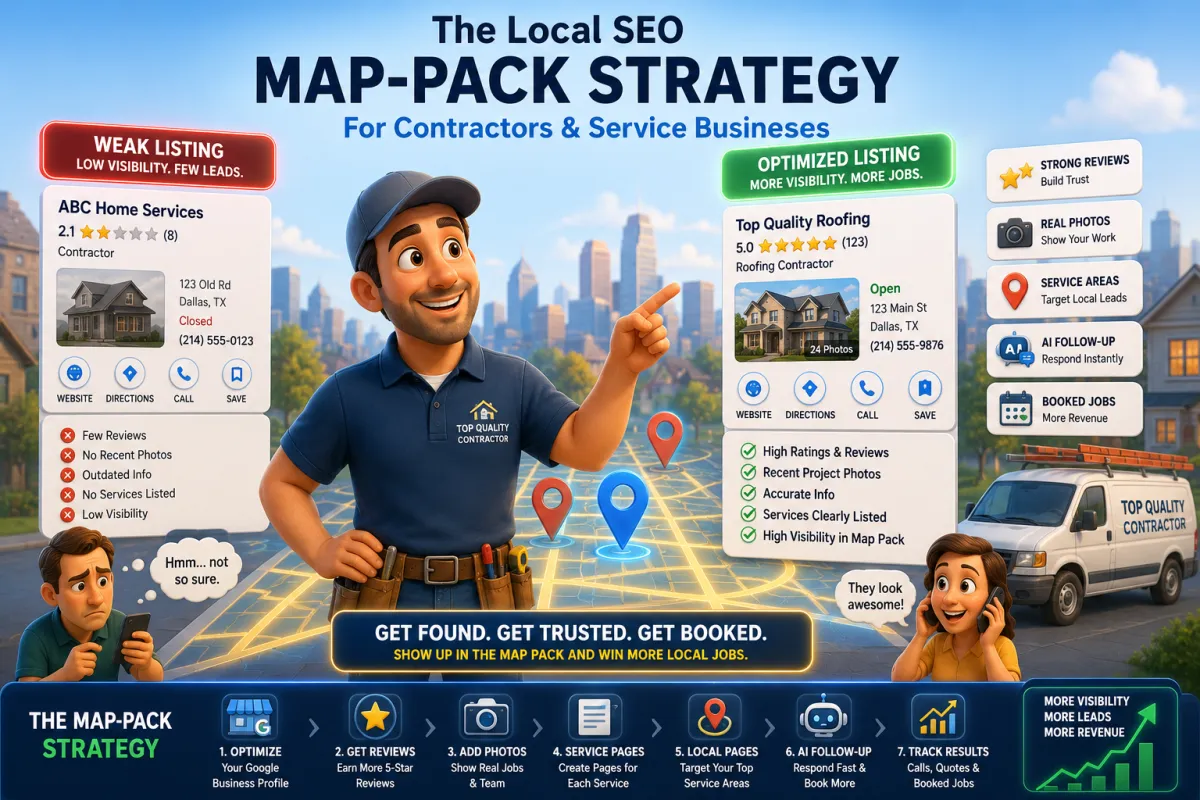
The Local SEO Map-Pack Strategy For Contractors And Service Businesses
If your business is not showing up in the Google Map Pack, you are losing high-intent leads.
Not someday.
Right now.
For contractors and service businesses, the Map Pack is where local buyers make fast decisions.
They search.
They compare.
They call.
They book.
And if your competitor shows up with better reviews, better photos, better service details, and a stronger local profile, they get the lead.
Not because they are better at the work.
Because they looked easier to trust.
What Is The Google Map Pack?
The Google Map Pack is the local business section that appears near the top of Google when someone searches for a local service.
You have seen it before.
It shows a map, business listings, star ratings, reviews, hours, phone numbers, and directions.
For service businesses, this is prime real estate.
Searches like these often trigger it:
Roof repair near me.
Emergency plumber in Dallas.
HVAC company near me.
Kitchen remodeler in Tampa.
Best electrician near me.
Concrete contractor in Phoenix.
These are not casual searches.
These people have intent.
They need help.
They are close to taking action.
That is why Map Pack visibility matters.
Why The Map Pack Matters For Contractors
Contractors and service businesses do not need random website traffic.
They need local leads.
Calls.
Quote requests.
Booked appointments.
Emergency jobs.
Consultations.
The Map Pack helps connect your business with people who are actively looking for your service in your area.
That makes it one of the most valuable places to show up online.
If your business is buried under competitors, you are not just missing visibility.
You are missing revenue.
The Three Things Google Looks At
Google local rankings are built around three core ideas:
Relevance.
Distance.
Prominence.
Relevance means how well your business matches the search.
Distance means how close your business is to the searcher or searched location.
Prominence means how trusted and well-known your business appears online.
You cannot control where the searcher is.
But you can improve relevance and prominence.
That is where the strategy lives.
Step 1: Fully Optimize Your Google Business Profile
Your Google Business Profile is the foundation.
Not optional.
Not “we’ll get to it later.”
Foundation.
Make sure your profile includes:
Correct business name.
Correct phone number.
Correct website.
Correct service area.
Accurate hours.
Primary business category.
Secondary categories.
Detailed services.
Strong business description.
Appointment or quote link.
Real photos.
Fresh updates.
If your profile is incomplete, outdated, or vague, you are making Google work too hard.
And Google is not your unpaid intern.
Make the information clear.
Step 2: Choose The Right Business Categories
Your primary category matters.
A roofer should not choose a vague category when “roofing contractor” fits better.
An HVAC business should not hide behind a general home services label.
A plumber, electrician, remodeler, landscaper, painter, or flooring company should use the most accurate category available.
Categories help Google understand what you do.
If your category is wrong, your relevance is weaker.
That can cost you visibility.
Step 3: Build Service Pages On Your Website
Your website supports your Map Pack strategy.
Your Google profile tells Google what your business is.
Your website helps prove it.
Each major service should have its own page.
For example, a roofing company might need pages for:
Roof repair.
Roof replacement.
Storm damage repair.
Emergency roof repair.
Metal roofing.
Commercial roofing.
A plumber might need pages for:
Drain cleaning.
Water heater repair.
Emergency plumbing.
Leak detection.
Sewer line repair.
Repiping.
Each page should explain the service, who it helps, what to expect, and how to request a quote.
Do not cram every service onto one messy page.
That is lazy structure.
And lazy structure rarely wins.
Step 4: Create Local Service Area Pages
If you serve multiple cities, your website should make that clear.
Create useful local pages for your strongest service areas.
Not thin copy-paste pages.
Real pages.
Each location page should include:
The city or area served.
Services offered there.
Local examples when possible.
Testimonials from nearby customers.
Photos from local jobs.
Common problems in that area.
A clear quote request CTA.
For example:
Roof Repair In Plano.
Emergency Plumbing In Scottsdale.
HVAC Repair In Fort Worth.
Kitchen Remodeling In Orlando.
Local pages help connect your services to the places you want to rank.
Step 5: Get More Real Reviews
Reviews are a major trust signal.
They help customers choose.
They also support your prominence.
Contractors should ask for reviews after completed jobs, successful repairs, and happy customer moments.
Keep it simple.
Send a text or email that says:
“Thanks again for choosing us.
If you had a good experience, would you mind leaving a quick Google review?
It helps more local homeowners find a contractor they can trust.”
Do not fake reviews.
Do not buy reviews.
Do not pressure people.
That shortcut can damage your reputation fast.
Earn real reviews.
Then respond to them.
Step 6: Respond To Every Review
A review response is not just for the customer who wrote it.
It is for every future customer reading it.
For positive reviews, thank them and mention the service naturally.
Example:
“Thanks, Mike.
We’re glad we could help with your roof repair and get the leak handled quickly.”
For negative reviews, stay calm.
Example:
“Thanks for the feedback.
We’re sorry your experience did not meet expectations.
Please contact our office so we can look into this directly.”
Do not argue in public.
That is not reputation management.
That is a free show.
Step 7: Add Real Job Photos
Photos matter for contractors.
People want to see proof.
Add photos of:
Completed jobs.
Before-and-after results.
Your team.
Your trucks.
Your equipment.
Your office.
Job sites.
Finished projects.
Emergency repairs.
Real photos build trust faster than stock images.
They also help your profile feel active and legitimate.
A contractor with no photos looks questionable.
A contractor with real work examples looks safer to call.
Step 8: Use Google Business Profile Posts
Google Business Profile posts give you a way to keep your listing fresh.
Use them to share:
Seasonal reminders.
Service highlights.
Recent projects.
Special offers.
Maintenance tips.
Emergency service updates.
Customer success stories.
Example:
“Storm season is here.
If you notice missing shingles, leaks, or water stains, schedule a roof inspection before the damage spreads.”
Simple.
Useful.
Local.
That is the goal.
Step 9: Add LocalBusiness Schema
Schema is code that helps search engines understand your business details.
For local service businesses, LocalBusiness schema can support details like:
Business name.
Address.
Phone number.
Hours.
Service area.
Business type.
Website.
Booking links.
You do not need to become a technical SEO expert.
But your website should have the right structure behind the scenes.
It helps search engines understand your business more clearly.
Step 10: Make Calling And Booking Easy
Map Pack traffic often comes from people ready to act.
Do not make them hunt.
Your profile and website should make it easy to:
Call.
Request a quote.
Book an appointment.
Send a message.
Get directions.
Ask a question.
If someone needs an emergency plumber, they are not reading your brand manifesto.
They want help now.
Make the next step obvious.
Step 11: Follow Up Fast
Local SEO gets attention.
Fast follow-up turns attention into revenue.
If someone submits a quote request and waits two days, they are probably gone.
AI follow-up can help by sending instant texts, emails, booking links, and qualifying questions.
This is where most contractors lose easy money.
They generate the lead.
Then follow-up is slow.
That is like catching the fish and dropping it back in the lake.
Bold strategy.
Bad outcome.
Step 12: Track Calls, Quotes, And Jobs
Rankings are useful.
But revenue is the real scorecard.
Track:
Phone calls.
Form submissions.
Quote requests.
Booked appointments.
Closed jobs.
Review growth.
Service-area performance.
Lead source.
Do not stop at “we rank higher.”
Ask whether the ranking is producing real business.
That is the part that pays payroll.
How Manic Marketing Helps
Manic Marketing helps business owners use AI marketing tools to generate more leads, book more appointments, and close more sales.
For contractors and service businesses, that means building a smarter local marketing system.
Not just chasing rankings.
That can include local SEO strategy, website improvements, AI follow-up, review systems, content creation, CRM workflows, and appointment booking support.
The goal is simple.
Show up locally.
Build trust fast.
Follow up instantly.
Turn searches into booked jobs.
That is how local SEO becomes a revenue system.
Final Takeaway
The Map Pack is one of the most valuable places for contractors and service businesses to show up.
But ranking there takes more than luck.
You need a complete Google Business Profile.
Strong reviews.
Accurate categories.
Real photos.
Service pages.
Local pages.
Schema.
Fast follow-up.
And a system that turns visibility into booked work.
Local SEO is not just about being found.
It is about being chosen.
That is the real win.
Want Help Turning Local Searches Into Booked Jobs?
Book a complimentary strategy call with the Manic Marketing team here:
https://manicmarketing.com/strategy-session
When you book, you will also get access to a 100 percent free AI Content Marketing tool.
It connects to your business’s social media profiles.
It uses AI to create content.
It can auto-post across up to 8 different platforms.
If your service business is showing up locally but not getting enough calls, quotes, or booked jobs, now is the time to fix the full system.
