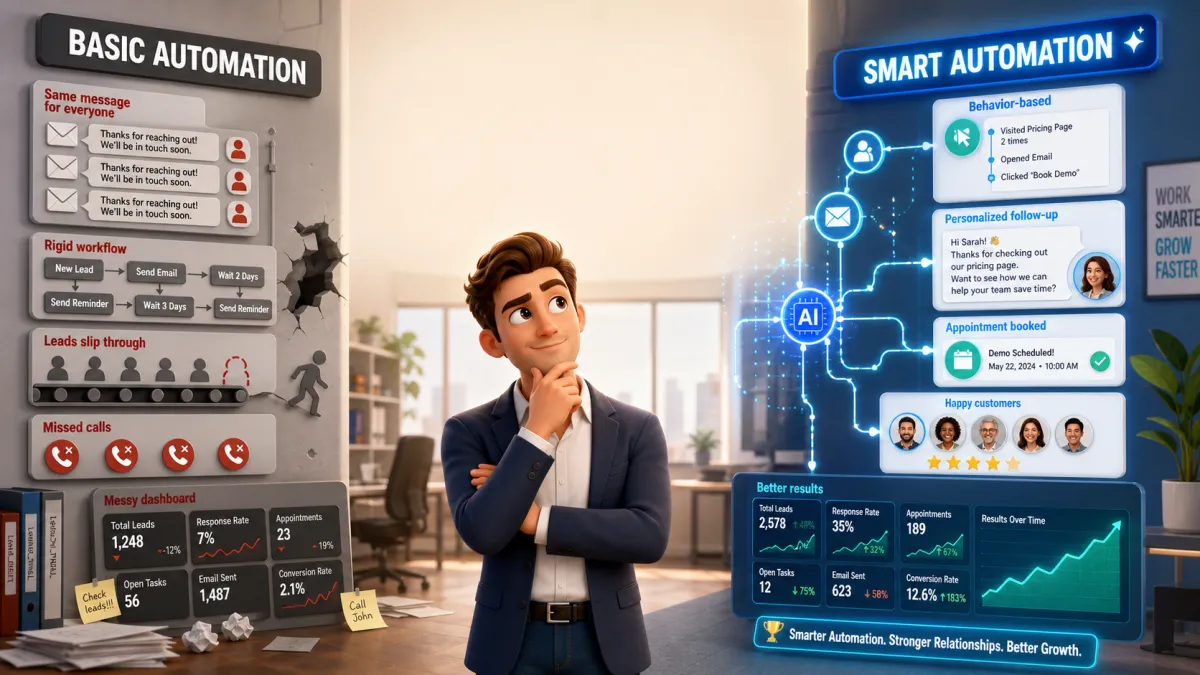
The Difference Between Automation And Smart Automation
A lot of businesses say they want automation.
What they really need is better decision-making inside their systems.
Because automation alone does not fix chaos.
It can actually scale it.
If your business is sending the wrong message, following up at the wrong time, or treating every lead the same, basic automation will not save you.
It will just help you make mistakes faster.
That is why the real conversation is not automation versus no automation.
It is automation versus smart automation.
What Automation Actually Means
Automation is any system that runs a task without someone manually doing it every time.
That can include:
Sending a follow-up email.
Booking a calendar reminder.
Sending a text after a form submission.
Moving a lead into a pipeline.
Assigning a task to a team member.
Posting content on a schedule.
Triggering an invoice.
Basic automation is about speed.
It removes repetitive work.
That is useful.
But speed without strategy is just a faster mess.
What Smart Automation Means
Smart automation does not just do things automatically.
It does the right thing based on context.
That is the difference.
Instead of blasting the same follow-up to everyone, smart automation adjusts based on behavior, timing, stage, and intent.
It responds to what is actually happening.
Not just what was scheduled three weeks ago.
Basic automation says:
“Send this email on Day 2.”
Smart automation says:
“If the lead did not reply, send this message.
If they clicked the offer, send that message.
If they booked, stop the reminders.
If they no-showed, trigger a rebooking sequence.
If they bought, move them into retention.”
That is a smarter system.
And smarter systems make more money.
Automation Follows Rules.
Smart Automation Follows Logic.
That is the cleanest way to think about it.
Automation is task-based.
Smart automation is outcome-based.
Automation checks a box.
Smart automation supports a result.
A basic workflow can save time.
A smart workflow can save time, improve conversion, protect customer experience, and create more revenue.
Big difference.
Why Basic Automation Often Fails
A lot of businesses install automation and then wonder why it is not helping much.
The answer is usually simple.
The automation is too shallow.
It is doing activity.
Not making decisions.
Here is what weak automation looks like:
Every lead gets the same email.
Every customer gets the same follow-up.
Every missed call gets the same response.
Every appointment reminder sounds identical.
Every old lead gets hit with the same promotion.
Every contact gets pushed through the same sequence no matter what they do.
That is not smart.
That is lazy automation.
And lazy automation feels robotic fast.
Customers can feel it.
Leads can feel it.
Your team usually feels it too.
The Problem With “Set It And Forget It”
A lot of people treat automation like a crockpot.
Throw it all in.
Walk away.
Hope dinner works out.
That is how bad systems get built.
A workflow should not just run.
It should adapt.
If your business changes, your automation should change.
If your offer changes, your automation should change.
If a lead becomes a customer, your automation should change.
If someone raises their hand, your messaging should change.
If someone ignores five emails in a row, your system should respond differently than it would for someone clicking every link.
That is the whole point.
A Real-World Example
Let’s say a medspa runs ads for a facial offer.
A basic automation system might do this:
Lead comes in.
Text goes out.
Email goes out.
Reminder goes out.
Same message for everyone.
That is better than no follow-up.
But it still has gaps.
Now look at smart automation.
Lead comes in.
They instantly get a text.
If they reply, the conversation shifts.
If they click the booking link but do not book, they get a softer reminder.
If they book, they stop getting sales nudges and move into appointment reminders.
If they no-show, they get a reactivation message.
If they come in, they get a post-visit follow-up, a review request, and a next-offer sequence.
If they buy a membership, they move into retention and upsell campaigns.
Same business.
Very different system.
One automates activity.
The other automates logic.
Smart Automation Uses Behavior
Behavior tells you what people actually care about.
That matters more than what you hope they care about.
Smart automation can respond to actions like:
Form submissions.
Link clicks.
Page visits.
Missed calls.
Appointment bookings.
No-shows.
Purchases.
Repeat purchases.
Review submissions.
Email opens.
Text replies.
Cart abandonment.
Consultation requests.
Each action is a signal.
Smart automation uses those signals to decide what happens next.
That makes your business feel more responsive.
More personal.
More relevant.
That usually means better results.
Smart Automation Reduces Friction
One of the biggest business killers is friction.
Slow follow-up.
Confusing communication.
Irrelevant messages.
Too many steps.
No clear next move.
Smart automation helps remove that.
It can remind people before they forget.
It can answer faster than a team member manually digging through messages.
It can move a lead to the right stage automatically.
It can stop sending the wrong message at the wrong time.
That protects the customer experience.
And customer experience affects conversion more than people like to admit.
Smart Automation Protects Your Brand
Bad automation makes a business feel cheap.
Or disconnected.
Or asleep at the wheel.
We have all seen it.
You buy something and keep getting “Are you still interested?” emails.
You book an appointment and still get pushed to book.
You reply to a message and get ignored because the system was one-way only.
You ask a question and get a canned answer that clearly missed the point.
That kind of automation does not make a business look efficient.
It makes a business look careless.
Smart automation protects against that by using better triggers, better filters, and better handoffs.
The Best Smart Automation Still Feels Human
This is where people get it wrong.
Smart automation should not feel more robotic.
It should feel more natural.
It should sound like someone on your team actually thought through the customer journey.
That means:
Clear messages.
Good timing.
Relevant follow-up.
Natural language.
Logical next steps.
Easy handoff when a real person is needed.
The goal is not to hide the fact that automation exists.
The goal is to make the automation useful enough that people do not care.
Signs Your Business Has Dumb Automation
Let’s be honest.
A lot of businesses are sitting on workflows that need help.
Here are the warning signs.
1. Everyone Gets The Same Sequence
If every contact gets the same emails, texts, and reminders no matter what they do, that is not smart automation.
That is a blanket.
And blankets do not convert leads.
2. The Timing Feels Off
If people get reminders after they already booked.
If customers get sales emails right after buying.
If leads wait hours or days for follow-up.
Your timing is broken.
3. Your Team Still Has To Manually Fix Everything
If automation creates extra cleanup work for your staff, it is not helping enough.
A strong system should reduce manual effort.
Not create a new pile of it.
4. Leads Fall Through The Cracks
If people inquire and never hear back.
If no-shows disappear forever.
If past customers never get reactivated.
Your system has holes.
5. Your Messages Feel Generic
If your automation sounds like a template factory with no pulse, it needs work.
People respond better when the message feels relevant.
Not recycled.
What Smart Automation Should Include
Smart automation is not about adding more tools.
It is about building better logic.
Here is what that usually includes.
1. Clear Triggers
Every automation should start with a meaningful action.
Examples:
A form fill.
A missed call.
A cart abandonment.
A booked appointment.
A purchase.
A no-show.
A review request.
No trigger.
No reason for the message.
2. Conditional Logic
This is where the system gets smarter.
If this happens, do that.
If it does not happen, do something else.
Simple logic makes a big difference.
3. Segmentation
Not every contact should be treated the same.
A new lead is different from a repeat buyer.
A hot lead is different from a cold one.
A first-time client is different from a loyal customer.
Good automation respects those differences.
4. Two-Way Communication
A lot of automations talk at people.
Smart automation creates room to respond.
It helps capture replies, route questions, and hand things off correctly.
5. Integration Across Systems
If your CRM, calendar, pipeline, forms, email, text, and sales process are all disconnected, your automation will stay clunky.
Smart automation works best when the system talks to itself.
6. Clear Handoffs
Not every moment should stay automated.
Some moments need a real person.
High-intent leads.
Complex questions.
Sales calls.
Support issues.
Complaint resolution.
Good systems know when to automate and when to hand off.
That is smart.
Smart Automation Saves More Than Time
Most people think automation is only about efficiency.
That is part of it.
But smart automation also helps with:
Lead conversion.
Customer retention.
Reactivation.
Team consistency.
Speed to lead.
Missed opportunity recovery.
Customer experience.
Revenue tracking.
Follow-up quality.
That is why this matters.
It is not just a productivity tool.
It is a growth tool.
AI Makes Smart Automation Even Better
AI takes automation a step further by improving how the system reacts.
Instead of only following rigid rules, AI can help shape better communication and better decisions inside the workflow.
That can include:
Writing more natural follow-up messages.
Personalizing responses.
Sorting leads by likely intent.
Generating content faster.
Summarizing conversations.
Suggesting next steps.
Identifying stale leads worth reactivating.
Supporting faster customer service.
This is where smart automation starts to feel less like software and more like a capable assistant.
Not perfect.
But far more useful than a rigid autoresponder from 2017.
Automation Without Strategy Is Just Noise
This is the part that matters most.
A lot of businesses buy tools before they fix the journey.
That is backwards.
Do not start with:
“What can this software do?”
Start with:
“What should happen when a lead comes in?”
“What should happen when someone does not reply?”
“What should happen after a purchase?”
“What should happen if someone goes quiet?”
“What should happen if someone is clearly ready to buy?”
Build the journey first.
Then automate the right parts.
That is how smart automation gets built.
A Simple Way To Think About It
Basic automation is like an automatic sprinkler.
It turns on at a set time whether the grass needs it or not.
Smart automation is like a gardener who checks the weather, the soil, and the condition of the yard before deciding what to do.
One follows a timer.
The other follows the situation.
That is the difference.
How To Upgrade From Automation To Smart Automation
If your current setup feels messy, do not overcomplicate the fix.
Start here.
Step 1. Map The Customer Journey
Look at what should happen from first contact to sale to retention.
Do not guess.
Write it out.
Step 2. Identify The Key Decision Points
Where do people usually get stuck?
Where do they drop off?
Where does your team lose time?
Where do leads need a different response?
Those are your smart automation opportunities.
Step 3. Clean Up Your Messaging
Shorter.
Clearer.
More relevant.
More human.
If the message sounds bad, automation will only spread it faster.
Step 4. Add Logic
Use simple rules first.
If booked, stop sales nudges.
If no-show, trigger rebooking.
If purchased, move to onboarding.
If inactive for 60 days, start reactivation.
Basic logic fixes a lot.
Step 5. Review The System Regularly
No workflow should be left untouched forever.
Watch results.
Check replies.
Listen to your team.
Update the system as the business grows.
That is how smart automation stays smart.
How Manic Marketing Helps
Manic Marketing helps business owners use AI marketing tools to generate more leads, book more appointments, and close more sales.
A big part of that is helping businesses move beyond basic automation.
We help build smarter systems that do more than send scheduled messages.
That includes AI follow-up, CRM workflows, content systems, lead nurturing, reactivation campaigns, and automations designed around actual customer behavior.
The goal is simple.
Less manual chaos.
Better follow-up.
More booked appointments.
More sales.
More control.
Because automation should not just save time.
It should help your business grow.
Final Takeaway
Automation is useful.
Smart automation is powerful.
Automation completes tasks.
Smart automation supports outcomes.
Automation sends messages.
Smart automation sends the right message at the right time to the right person.
That is the standard businesses should aim for.
If your current workflows are generic, clunky, or creating more confusion than clarity, you do not need more automation.
You need better automation.
That is the real upgrade.
Want Help Building Smarter Automation For Your Business?
Book a complimentary strategy call with the Manic Marketing team here:
https://manicmarketing.com/strategy-session
When you book, you will also get access to a 100% free AI Content Marketing tool.
It connects to your business social media profiles.
It uses AI to create content.
It can auto-post across up to 8 different platforms.
If your business is stuck with basic workflows that are not turning into real results, now is the time to fix the system.
