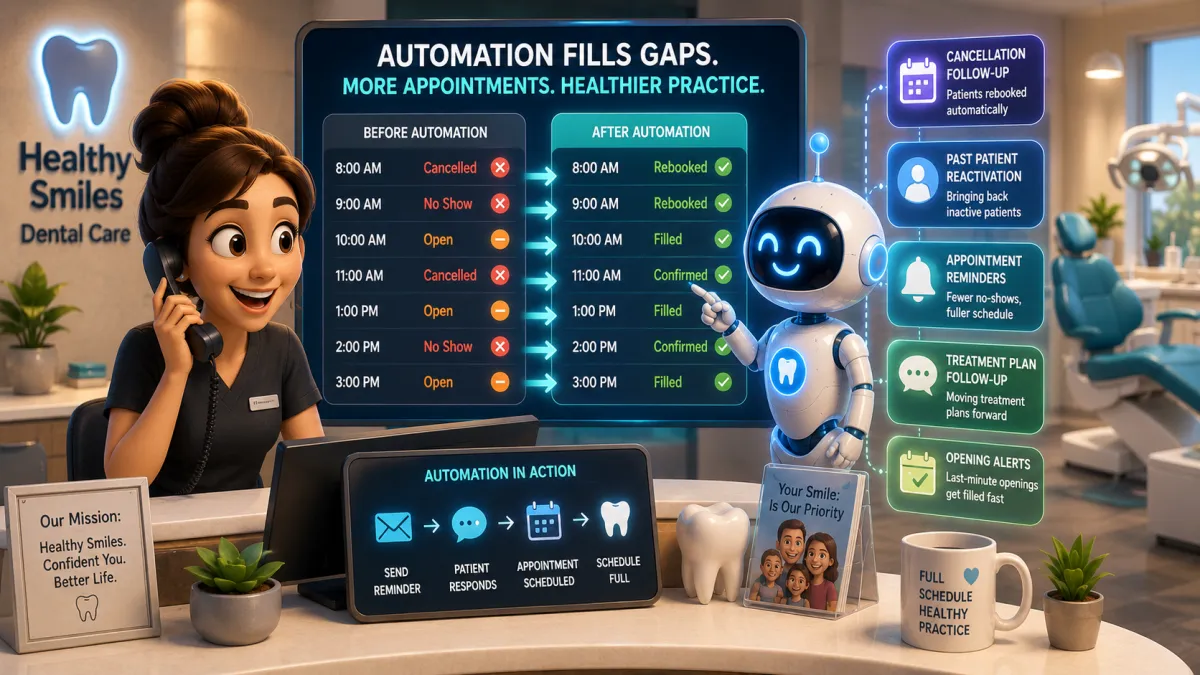
How Automation Fills Gaps In The Schedule For Dentists
Empty appointment slots do not just hurt the schedule.
They hurt production, team efficiency, and patient flow.
For dentists, automation can help fill those gaps by following up faster, reactivating patients, and keeping the calendar moving without forcing the front desk to chase everyone manually.
Why Schedule Gaps Are So Expensive
A dental schedule is not just a calendar.
It is the heartbeat of the practice.
Every open slot affects production.
Every cancellation creates a gap.
Every missed hygiene appointment pushes revenue further out.
And every patient who meant to reschedule but never did becomes one more lost opportunity.
The problem is not always lack of demand.
The problem is usually lack of follow-up.
Where Dental Schedules Start Breaking Down
Most dental teams are busy.
They are answering phones.
Checking patients in.
Verifying insurance.
Handling billing questions.
Managing treatment plans.
Helping patients at the desk.
So when someone cancels, misses an appointment, or needs to be rebooked, it is easy for follow-up to fall behind.
That is how small gaps turn into bigger schedule problems.
One missed call.
One forgotten text.
One unscheduled patient.
One open chair.
It adds up fast.
How Automation Helps Fill Schedule Gaps
1. Automation Follows Up With Cancelled Patients
When a patient cancels, the system should not stop there.
Automation can send follow-up messages to help get them back on the schedule.
The message can be simple.
“Hey Sarah, we saw your appointment was cancelled.
Want help finding another time this week?”
That is better than letting the patient disappear into the void.
The dental void is real.
And it is expensive.
2. Automation Reactivates Past Patients
Every dental practice has patients who have not been in for a while.
They meant to book.
They got busy.
They forgot.
They moved the reminder to “later.”
Then later never happened.
Automation can help re-engage those patients with friendly reminders for cleanings, exams, whitening, treatment plans, or unfinished dental work.
That gives your practice a steady way to bring people back without manually calling every name in the database.
3. Automation Fills Last-Minute Openings
When a slot opens, speed matters.
Automation can help notify patients who may want an earlier appointment.
That includes hygiene patients, treatment patients, or people waiting for a better time.
Instead of leaving the chair empty, your system can start working to fill the opening.
An open slot is only wasted if nobody gets asked to take it.
4. Automation Confirms Appointments
No-shows are one of the easiest ways to lose production.
Automation can help reduce that by sending reminders and confirmation messages before the appointment.
Patients can confirm, reschedule, or ask questions without having to call.
That keeps the schedule cleaner.
It also gives your team more warning when a slot is at risk.
5. Automation Moves Treatment Plans Forward
A lot of production sits in unscheduled treatment.
Patients know they need the work.
They just have not booked yet.
Automation can help follow up with those patients in a simple, helpful way.
It can remind them about the recommended treatment.
Answer basic questions.
Prompt them to schedule.
And keep the conversation alive.
That matters because treatment acceptance does not always happen in one conversation.
The follow-up is where many appointments get saved.
Why This Matters For Dental Practices
A full dental schedule does not happen by accident.
It comes from consistent communication.
Patients need reminders.
They need clear next steps.
They need easy ways to book.
And they need follow-up that does not depend on one busy person remembering every detail.
Automation gives your practice a better system.
It helps protect the schedule.
It supports the front desk.
It keeps patients engaged.
And it helps reduce the daily chaos that comes from trying to manage everything manually.
Where Manic Marketing Fits In
At Manic Marketing, we help business owners use AI marketing tools to generate more leads, book more appointments, and close more sales.
For dental practices, that means building smarter systems that help keep the calendar full.
AI and automation can help respond to leads, follow up with patients, re-engage past patients, and move people toward booked appointments.
That means fewer missed opportunities.
Fewer empty chairs.
And more consistency in the schedule.
The Bottom Line
Schedule gaps cost dental practices real money.
Automation helps fix the problem by following up faster, rebooking patients, filling openings, and keeping communication consistent.
Your team should not have to manually chase every patient, every cancellation, and every unscheduled treatment plan.
That is what systems are for.
If you want help using AI and automation to generate more leads, book more appointments, and fill more gaps in your dental schedule, book a complimentary strategy call with the Manic Marketing team here:
https://manicmarketing.com/strategy-session
When you book, you will also get access to a 100% free AI Content Marketing tool that connects to your business social media profiles and uses AI to create and auto-post content across up to 8 platforms.
