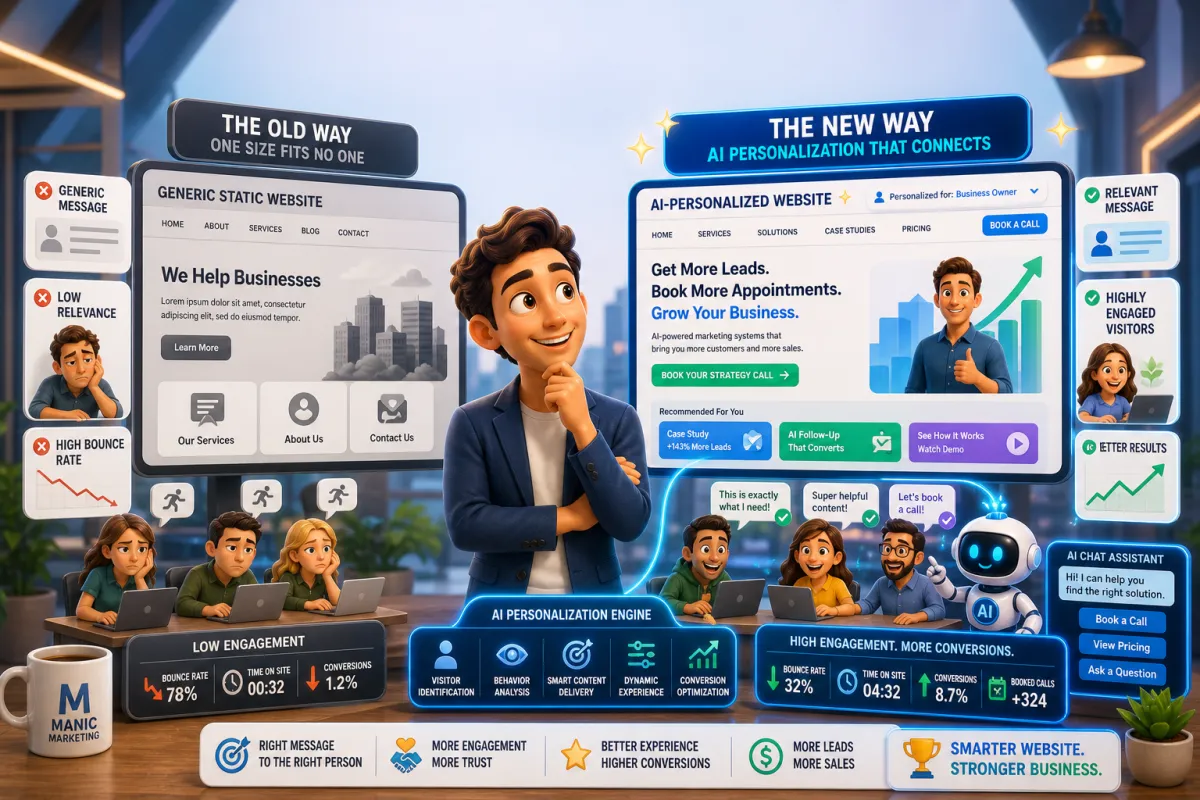
How AI Personalization Changes Website Engagement
Most websites still treat every visitor the same.
That is a problem.
Because not every visitor shows up with the same intent, the same question, or the same level of trust.
A first-time visitor from a Facebook ad should not get the exact same experience as a returning visitor who already clicked three pages and looked at your pricing.
That is where AI personalization changes the game.
It helps your website stop acting like a static brochure and start acting more like a smart salesperson.
And when a website feels more relevant, engagement gets stronger.
What AI Personalization Actually Means
AI personalization is the process of adjusting the website experience based on who the visitor is, what they are doing, and what they seem to care about.
That can include changing:
Headlines.
Calls to action.
Recommended content.
Product suggestions.
Chat prompts.
Lead magnets.
Case studies.
Page sections.
Offers.
Follow-up paths.
Instead of showing the same message to everyone, the website becomes more responsive.
Think of it like walking into a store.
If every customer heard the same canned pitch no matter what they needed, the experience would feel lazy.
A smart salesperson listens first.
Then they guide the customer to the right next step.
AI personalization helps your website do that.
Why Generic Websites Lose Engagement
Most websites are too broad.
They try to speak to everyone.
So they end up connecting with nobody.
A visitor lands on the site and sees vague copy.
Generic headlines.
Weak calls to action.
No clear path.
No sense that the business understands what they actually want.
That is when people bounce.
Not because websites do not matter.
Because irrelevant websites do not matter.
Engagement drops when the message feels disconnected from the visitor’s needs.
If someone visits your site looking for one specific solution and your homepage sounds like it was written for ten different audiences at once, they leave.
Fast.
Website Engagement Is Not Just About Design
A lot of business owners think engagement problems are a design problem.
Sometimes they are.
But a beautiful website with weak messaging is still a weak website.
Engagement is really about relevance.
Do people see something that feels useful?
Do they understand what you do?
Do they feel like they are in the right place?
Do they know what step to take next?
AI personalization helps answer those questions faster.
Because it helps the website show more relevant information based on the visitor’s behavior and context.
AI Personalization Makes The Website Feel More Human
That sounds ironic.
But it is true.
A static website feels robotic.
It shows the same thing no matter what the visitor wants.
A personalized website feels more aware.
It can respond to behavior.
It can highlight the most relevant service.
It can surface the right offer.
It can guide the visitor based on intent.
That creates a smoother experience.
And smoother experiences usually create better engagement.
Because people stay longer when the website makes sense.
The Best Websites Do Not Just Inform.
They Adapt.
That is the real shift.
Old websites were digital brochures.
New websites should act more like living systems.
They should notice what visitors are doing.
They should guide them more intelligently.
They should reduce confusion.
They should shorten the path to action.
AI personalization helps do exactly that.
It gives your website the ability to respond instead of just exist.
That matters because attention is expensive.
If you worked hard to get the click, your website should work hard to keep it.
How AI Personalization Improves Website Engagement
Let’s get practical.
Here is how AI personalization changes the experience in ways that directly affect engagement.
1. It Improves Relevance Right Away
First impressions decide a lot.
If the first screen feels relevant, people stay.
If it feels generic, they leave.
AI personalization can help show different headline angles based on the visitor source.
For example:
A visitor coming from a paid ad about lead generation could see a homepage section focused on getting more qualified leads.
A visitor coming from a blog about AI follow-up could see a section focused on converting leads faster.
Same website.
Different first impression.
That creates stronger relevance.
And relevance drives engagement.
2. It Creates Better Calls To Action
Not every visitor should get the same call to action.
One person may be ready to book.
Another may need more trust first.
Another may need education.
AI personalization can help adjust the next step.
That might mean showing:
“Book A Strategy Call.”
“See How It Works.”
“Watch A Demo.”
“Get The Case Study.”
“Read More About AI Follow-Up.”
That is important because engagement improves when the next step matches the visitor’s stage of awareness.
A weak website pushes one action.
A smarter website guides people into the right action.
3. It Keeps Visitors On The Site Longer
People stay longer when the content feels useful.
AI personalization can recommend the next best page, article, service, or offer based on what the visitor already viewed.
If someone reads a blog about warm leads, the website could recommend content about follow-up systems, email marketing, or pipeline conversion.
If someone visits a web design page, the site could suggest content about SEO, AEO, or AI-powered lead capture.
That helps visitors go deeper.
And deeper engagement usually means better trust.
4. It Reduces Bounce From The Wrong Traffic
Not all traffic is equal.
Some visitors are a strong fit.
Some are just browsing.
Some are confused.
AI personalization can help segment those visitors faster and guide them appropriately.
If someone lands on the wrong page but clearly starts clicking around a certain topic, the website can surface more relevant content before they disappear.
That saves attention that would otherwise be lost.
5. It Helps Answer Questions Faster
A lot of visitors leave because they still have unanswered questions.
AI personalization can improve this by surfacing:
Relevant FAQs.
Helpful chat prompts.
Industry-specific case studies.
Pricing guidance.
Location details.
Trust-building proof.
When a visitor gets answers faster, they do not need to hunt.
That matters.
Because confused people rarely convert.
6. It Makes The Website More Useful For Returning Visitors
A returning visitor is different from a first-time visitor.
They already know something about you.
They may not need the same introduction.
AI personalization can recognize returning behavior and show more advanced content or stronger conversion-focused calls to action.
That could mean:
Showing a case study instead of a generic intro.
Highlighting the booking page.
Offering a consultation.
Showing proof.
Promoting a specific service based on previous visits.
That makes the second or third visit stronger than the first.
And that is where a lot of buying decisions happen.
AI Personalization Works Across Different Website Types
This is not only for big brands.
It matters for local businesses, service providers, consultants, ecommerce stores, and agencies too.
Here are a few examples.
For Service Businesses
A medspa website could personalize content based on the service page visited most.
Someone viewing facial pages could see a skin consultation offer.
Someone viewing injectables could see FAQs, before-and-after content, and a consult CTA.
A chiropractor website could highlight neck pain content for visitors browsing that issue.
A dentist website could surface emergency appointment information for visitors coming from urgent search terms.
That is useful personalization.
Not gimmicks.
For Ecommerce Stores
An ecommerce website can personalize product recommendations, best sellers, bundles, and related items based on browsing behavior.
If someone looked at glasses, the website can show similar styles, best-reviewed options, or a buy one take one bundle.
If someone abandoned a product page, the next visit can spotlight that product again.
That keeps the buying path warmer.
For B2B Companies
A B2B website can personalize by industry, visitor source, or funnel stage.
A roofing company owner and a chiropractor should not land on the same version of a marketing agency page and see equally vague messaging.
Different business types care about different outcomes.
One may care about appointment bookings.
Another may care about lead generation.
Another may care about customer retention.
AI personalization helps the site speak more clearly to each one.
For Agencies And Consultants
Agencies can personalize content based on niche, offer interest, or traffic source.
That means the website can feel more aligned without needing ten separate websites.
It can highlight the most relevant proof.
The most relevant service.
The most relevant case study.
The most relevant CTA.
That makes the website feel sharper.
And sharp websites engage better.
Personalization Helps Build Trust Faster
Trust does not come from fancy buzzwords.
It comes from clarity and relevance.
When a website shows the visitor something that matches their situation, it signals understanding.
It says:
“We get why you are here.”
That matters.
Because people buy faster when they feel understood.
A generic website makes the visitor do all the work.
A personalized website does more of the lifting.
That makes the business feel more capable.
AI Personalization Also Helps Conversion
Website engagement is important.
But it is not the final goal.
The real goal is movement.
More clicks.
More time on site.
More booked calls.
More form fills.
More purchases.
More qualified leads.
AI personalization helps because it reduces friction between interest and action.
It shortens the distance between what the visitor wants and what the website shows them next.
That makes conversion easier.
And when conversion gets easier, engagement becomes more valuable.
Signs Your Website Needs Better Personalization
If your site has any of these issues, it probably needs work.
High bounce rate.
Low time on site.
Weak conversion rate.
Lots of traffic but few leads.
Visitors hitting the homepage and leaving.
Generic messaging across all pages.
No clear content path.
One-size-fits-all calls to action.
Weak follow-up after form submissions.
These problems are common.
They also cost money.
Because every ignored visitor is a missed opportunity.
The Biggest Mistake Businesses Make
The biggest mistake is thinking personalization means adding a chatbot and calling it a day.
That is not enough.
A chatbot can help.
But real personalization is broader than that.
It includes the message.
The path.
The offer.
The content.
The call to action.
The proof.
The experience.
If the only “personalization” on your site is a pop-up that says someone is here to help, you are not exactly pushing the limits.
You are just decorating the problem.
Smart Personalization Starts With Visitor Intent
Before you personalize anything, you need to understand what different visitors are likely trying to accomplish.
Ask questions like:
Why are they here?
What problem are they trying to solve?
What page did they land on?
What traffic source brought them in?
What stage are they in?
What objection might they have?
What next step makes the most sense?
That is where good personalization starts.
Not with tools.
With customer logic.
How To Add AI Personalization Without Making Your Website Weird
A lot of businesses overthink this.
You do not need your website to feel creepy or overly complex.
You need it to feel useful.
Start simple.
1. Personalize Headlines By Traffic Source
If people arrive from different ads or campaigns, make sure the page reflects that message.
Message match matters.
2. Show The Right CTA Based On Behavior
If someone keeps reading educational content, offer a guide or case study.
If they are spending time on pricing or service pages, offer a booking CTA.
3. Recommend Next Best Content
Use browsing behavior to guide visitors to the next useful page.
This helps keep attention moving.
4. Surface Relevant Proof
Show testimonials, examples, or case studies that match the visitor’s likely industry or interest.
5. Improve Website Chat
Instead of generic chat prompts, use smarter prompts tied to the page topic.
A good prompt is more likely to create interaction.
6. Follow Up Based On What They Viewed
If someone fills out a form after viewing a certain service, the follow-up should reflect that interest.
This is where website personalization and CRM automation start working together.
AI Personalization Works Best With Good Strategy
This matters.
AI personalization is not a magic trick.
If your offer is weak, your copy is vague, or your site structure is messy, personalization will not fix the core problem.
It will just personalize the mess.
That is why strategy comes first.
You need:
Clear positioning.
Clear offers.
Clear pages.
Clear next steps.
Clear proof.
Then AI can help make the experience more intelligent.
That is the winning order.
Why This Matters More Now
Online attention is harder to hold.
People move fast.
They compare fast.
They judge fast.
If your website feels generic, they leave before you get a second chance.
AI personalization helps your website keep up with that reality.
It helps the site feel more dynamic.
More relevant.
More useful.
That is what modern engagement looks like.
Not flashy animation.
Better alignment between what the visitor wants and what the website delivers.
How Manic Marketing Helps
Manic Marketing helps business owners use AI marketing tools to generate more leads, book more appointments, and close more sales.
That includes helping businesses build smarter websites.
Not just prettier ones.
We help create websites and marketing systems that do more than sit there looking polished.
They are built to guide visitors, improve engagement, capture leads, and support stronger conversion.
That can include website strategy, AI marketing systems, content support, smarter follow-up, and tools that help the website feel more responsive to real visitor behavior.
Because a website should not be a dead page.
It should be an active part of your sales process.
Final Takeaway
AI personalization changes website engagement because it makes the experience more relevant.
Relevant websites hold attention longer.
They answer questions faster.
They guide people more clearly.
They create better next steps.
They build trust faster.
That is why personalization matters.
Not because it sounds advanced.
Because it helps the website do a better job.
If your website still treats every visitor exactly the same, it is leaving engagement on the table.
And if it is leaving engagement on the table, it is probably leaving revenue there too.
Want Help Building A Smarter Website That Engages Better And Converts More?
Book a complimentary strategy call with the Manic Marketing team here:
https://manicmarketing.com/strategy-session
When you book, you will also get access to a 100 percent free AI Content Marketing tool.
It connects to your business’s social media profiles.
It uses AI to create content.
It can auto-post across up to 8 different platforms.
If your website is getting traffic but not enough action, now is the time to make it smarter.
